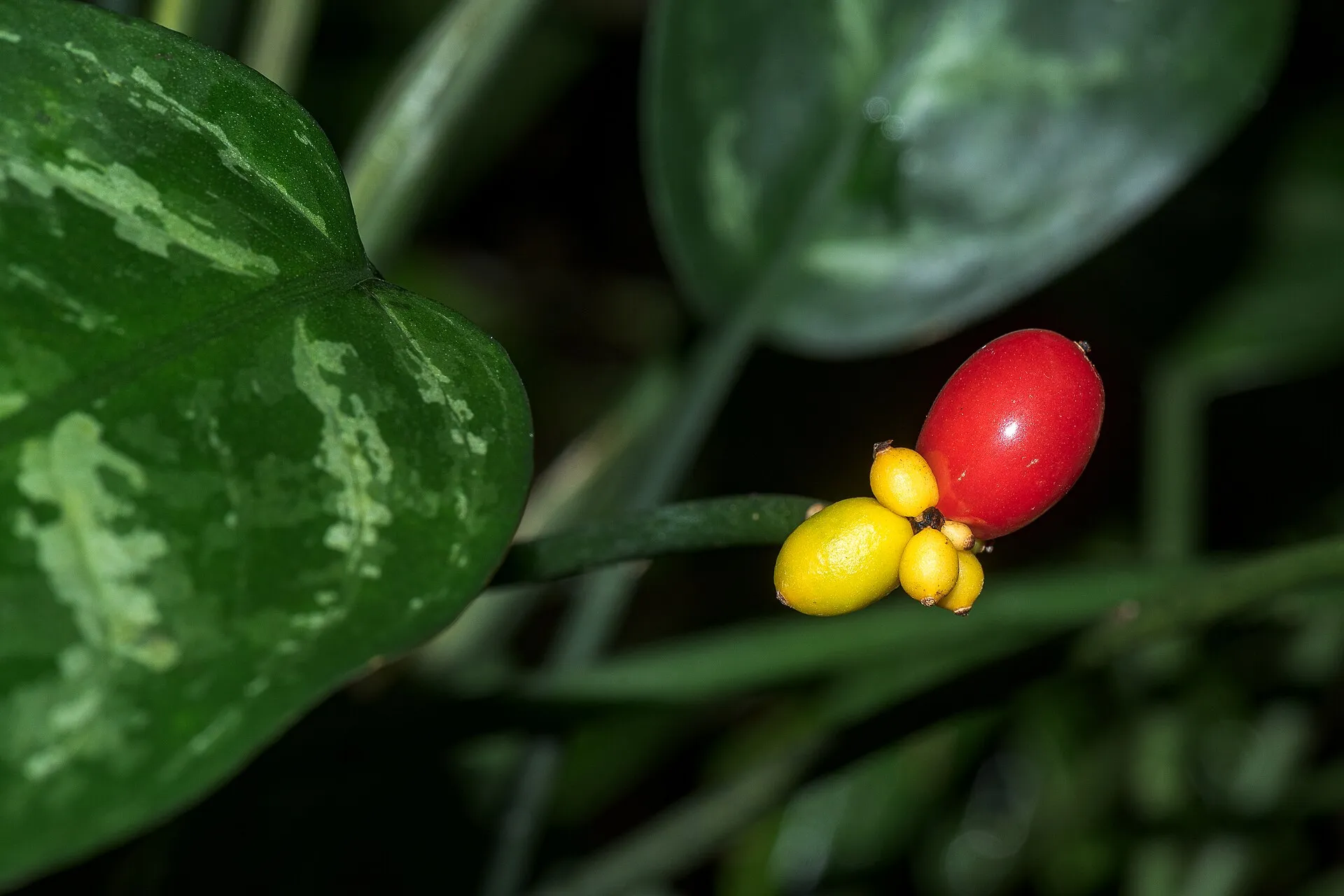
Aglaonema commutatum has broad leaves marked in silver, cream and green. It is one of very few patterned plants that holds its markings in low light, where most variegated foliage reverts to plain green.
That makes it genuinely useful for the parts of a home other plants cannot cope with.
Light
Aglaonema commutatum grows best in medium indirect light, and tolerates low light well.
The colour of the variety matters here. The dark green and silver forms handle genuinely dim corners. The pink and red ones need brighter indirect light to hold their colour and will fade without it.
Too much light
Direct sun scorches the leaves and bleaches the pattern.
Watering
Water when the top 3-5cm (1-2 inches) of soil is dry. It grows slowly and uses water slowly, so it is easy to overdo.
On average:
- Spring & summer: once every 1-2 weeks
- Autumn & winter: once every 3 weeks
Water considerably less if the plant is in a dim spot. Low light and a regular watering routine is the combination that rots them.
Signs of overwatering
- Leaves yellow from the base upward
- Stems go soft at soil level
- Soil stays wet for over a week
Signs of underwatering
- Leaves droop and lose their stiffness
- Leaf edges go dry and brown
Humidity and temperature
Ordinary household humidity is acceptable, though above 50% keeps the leaf edges cleaner.
Cold is the one thing Aglaonema commutatum will not forgive. Keep it above 16°C (61°F). Below that the leaves develop dark, greasy-looking patches that never recover, and a cold draught in winter can do it in a single night.
Soil and repotting
Soil
Standard potting compost with perlite mixed through for drainage.
Repotting
Every 2 to 3 years in spring. It grows slowly and is happy pot-bound, so there is rarely any rush.
Feeding
Balanced liquid fertiliser every 6 to 8 weeks through spring and summer. Nothing in winter, and nothing at all if the plant is in low light and barely growing.
Pruning and grooming
Remove yellowed leaves at the base with clean scissors.
Older plants lose their lower leaves and develop a bare stem. Cut the stem back hard in spring and it will resprout from the base, or take the top as a cutting and root it.
Wipe the leaves occasionally to keep the silver markings visible.
Common problems
Dark greasy patches on the leaves
Cold damage. Move the plant somewhere warmer and away from draughts. The damaged leaves will not recover.
Yellow leaves
Overwatering, especially in low light. Let the soil dry further between waterings.
Faded pink or red colouring
Not enough light for that variety. Move it brighter.
Brown crispy leaf edges
Dry air, or minerals from tap water building up in the soil.