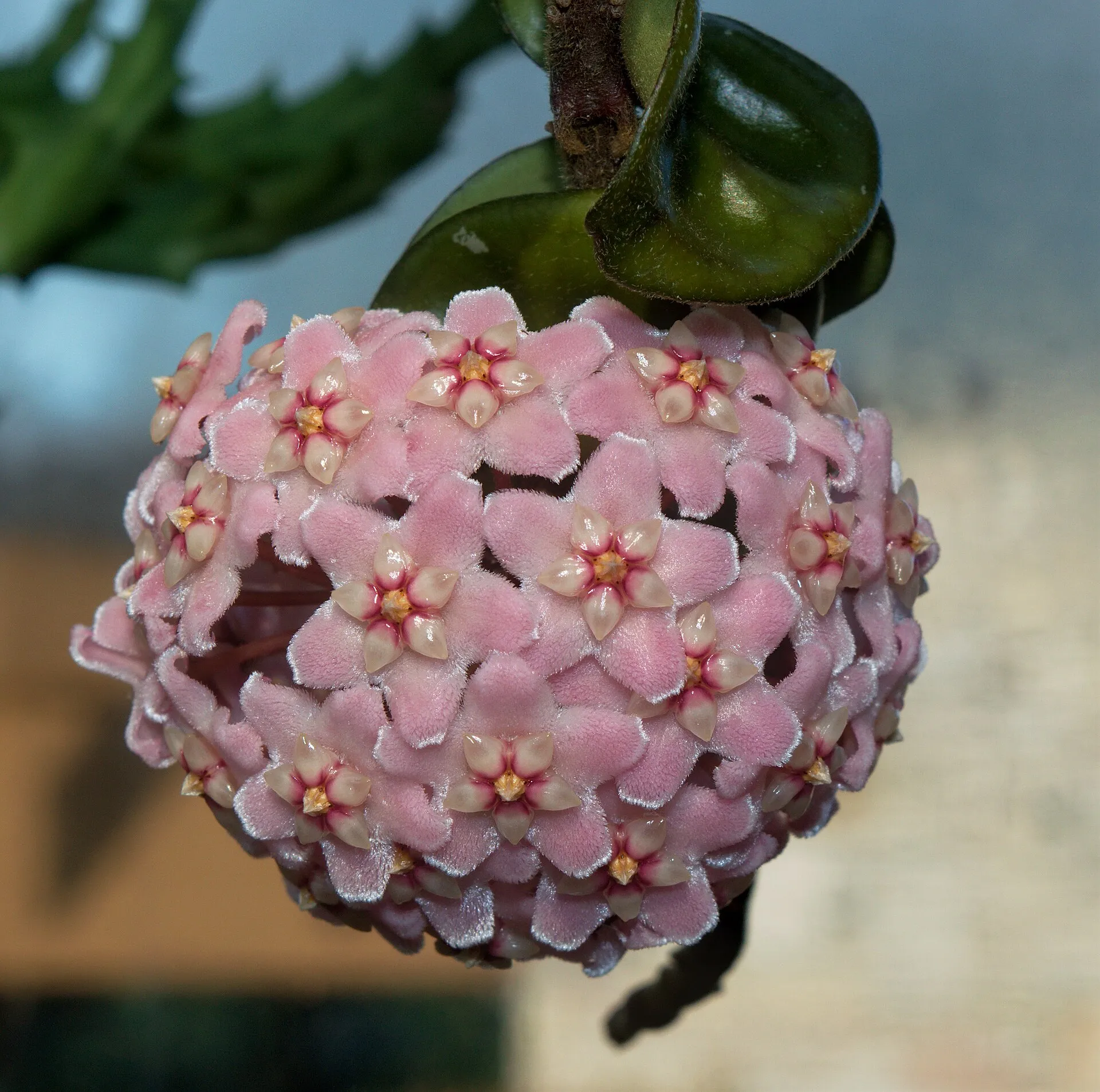
Hoya carnosa trails thick, waxy leaves along wiry stems and produces clusters of small star-shaped flowers that look moulded from porcelain. The flowers are scented, most strongly in the evening.
It is an epiphyte, growing on tree branches rather than in soil, which explains why it wants a chunky mix and a small pot.
Light
Hoya carnosa grows best in bright, indirect light, and a couple of hours of direct morning sun is good for it. Light is the main lever on whether it flowers.
Too little light
The plant survives happily but will not flower, and the leaves lose any red or silver flecking.
Too much light
Long hours of hot afternoon sun bleach the leaves to a yellowish green.
Watering
Water thoroughly when the soil is dry throughout, then let it drain fully. The thick leaves store water, so this plant handles drought far better than damp soil.
On average:
- Spring & summer: every 2 weeks
- Autumn & winter: every 3-4 weeks
Signs of overwatering
- Leaves yellow and drop
- Stems go black near the soil
- Soil stays wet for over a week
Signs of underwatering
- Leaves wrinkle and dimple
- Leaves feel soft rather than firm
Wrinkled leaves plump back up within a day of watering. Blackened stems do not recover.
Humidity and temperature
Ordinary household humidity is fine, though higher humidity speeds up growth.
Keep it between 15°C and 27°C (59-80°F). A cooler winter rest, around 15°C (59°F), actually encourages flowering the following year.
Soil and repotting
Soil
A chunky, fast-draining mix with plenty of orchid bark and perlite. Standard compost holds far too much water around epiphytic roots.
Repotting
As rarely as possible. Hoya carnosa flowers best when pot-bound, and repotting into something roomy typically delays flowering by a year or more.
Only repot when the plant is visibly struggling or the mix has broken down.
Feeding
Balanced liquid fertiliser once a month through spring and summer. A high-potassium feed in spring encourages flowering.
Pruning and grooming
Prune as little as possible. The long bare tendrils that appear are how the plant searches for something to climb, and they often produce leaves and flower spurs later. Cutting them off removes future growth.
Never remove the spurs
Flowers appear on short stubby stems called spurs, and the same spur flowers again every year. After the flowers drop, the spur looks like a dead twig. Leave it alone.
Common problems
No flowers
Too little light, too large a pot, or the plant is too young. In that order.
Wrinkled leaves
Thirst. Water it and they recover within a day.
Black stems at soil level
Overwatering and rot. Take cuttings from healthy growth above the damage.
Sticky leaves
Either flower nectar, which is normal and harmless, or scale insects. Check the undersides to tell which.