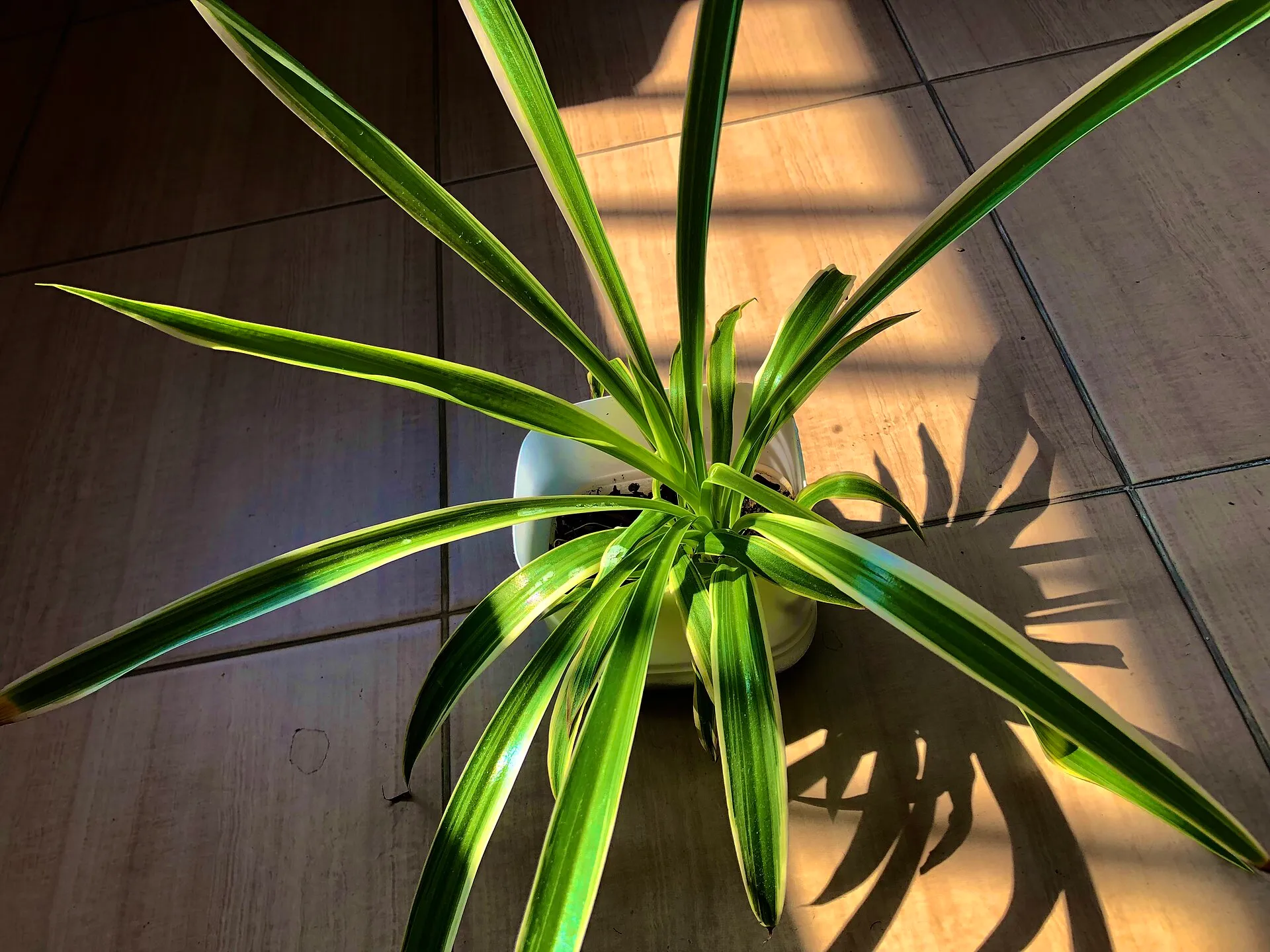
Chlorophytum comosum answers the most common question in houseplant ownership: what can I have that will not hurt my cat? It is genuinely non-toxic, genuinely easy, and it propagates itself.
Light
Chlorophytum comosum grows best in bright, indirect light, which gives the strongest variegation and the most plantlets.
It tolerates medium light happily, though a spider plant in a dim corner stops producing runners and the white stripes wash out.
Too much light
Direct afternoon sun bleaches and scorches the leaves.
Watering
Water when the top 3cm (1 inch) of soil is dry. This plant is thirstier than most beginner plants, because it stores water in thick white roots and grows fast enough to use it.
On average:
- Spring & summer: twice a week
- Autumn & winter: once a week
Signs of overwatering
- Leaves yellow from the centre of the clump
- Base goes soft and brown
- Soil stays wet for days
Signs of underwatering
- Leaves go pale and droop
- Leaf tips go brown and dry
Water quality matters
Chlorophytum comosum is unusually sensitive to fluoride and chlorine in tap water, and it shows as brown leaf tips. Use filtered water, or leave tap water standing overnight before using it.
Humidity and temperature
Average household humidity is fine, though higher humidity reduces the brown tips.
It tolerates a wide range, roughly 13°C to 27°C (55-80°F), and is one of the few houseplants genuinely comfortable in a cool room.
Soil and repotting
Soil
Standard potting compost with added perlite for drainage.
Repotting
When the thick white roots start pushing the plant up out of its pot, which they will. Go up one size only.
Spider plants flower and produce the most plantlets when slightly pot-bound, so an oversized pot works against you.
Feeding
Balanced liquid fertiliser once a month through spring and summer. Nothing in winter.
Go easy. Overfeeding contributes directly to the brown leaf tips, because this plant is sensitive to salt build-up.
Pruning and grooming
Trim brown tips with scissors at an angle, following the natural leaf shape. Cut spent runners back to the base.
Remove plantlets whenever you want more plants, or leave them attached for the cascading look.
The plantlets are the point
A happy, slightly pot-bound Chlorophytum comosum sends out long runners tipped with miniature versions of itself. These are complete baby plants.
Pin one onto a pot of moist soil while it is still attached to the parent, wait about two weeks for roots to take, then snip the runner. It is the most reliable propagation of any houseplant and works essentially every time.
Common problems
Brown leaf tips
Water quality first, overfeeding second.
No runners
The plant is too young, or the pot is too large.
Faded, washed-out variegation
Not enough light.
Limp, pale leaves
Underwatered, or the roots have filled the pot so completely there is no soil left to hold water.