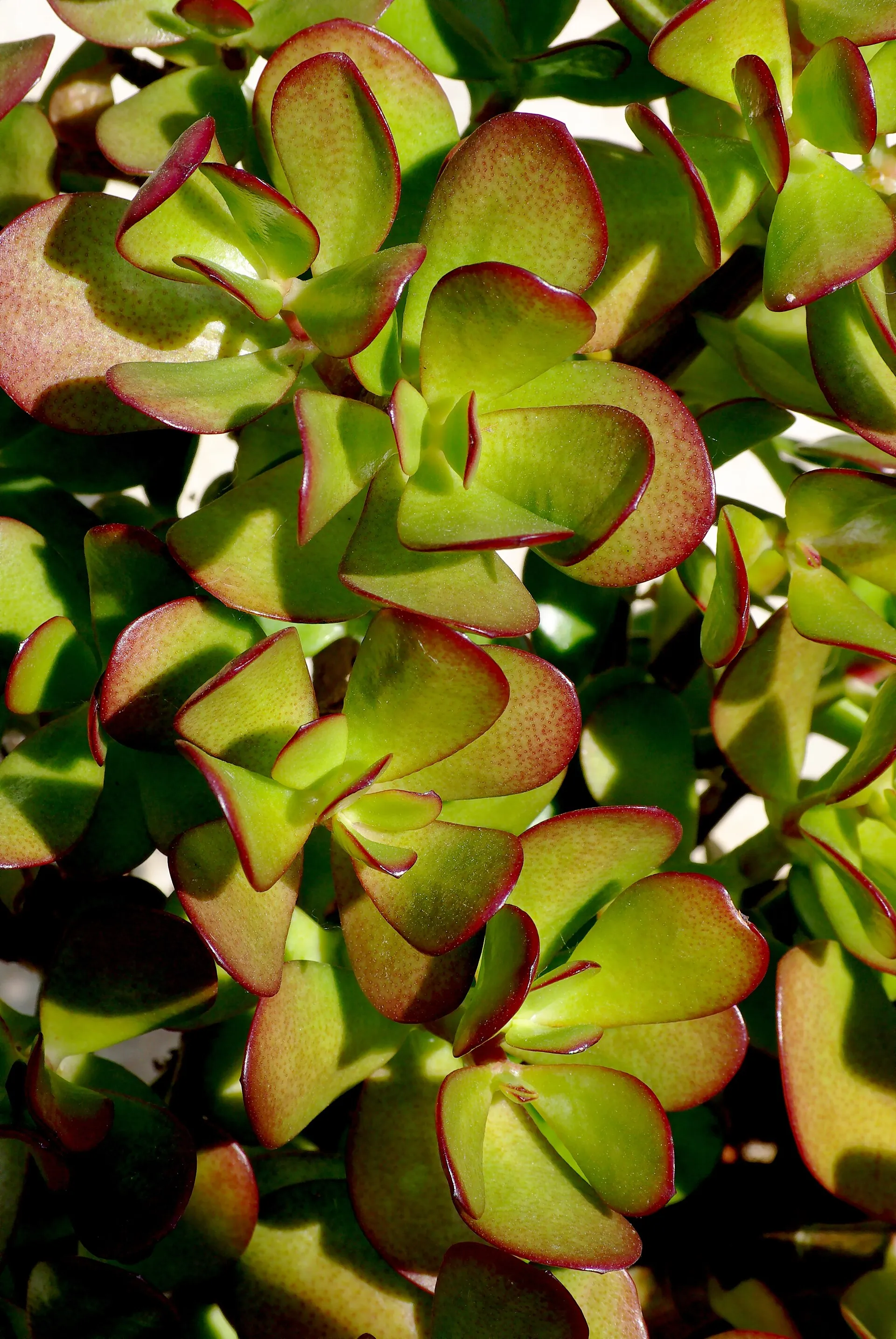
Crassula ovata is a succulent that slowly builds a thick woody trunk and lives for decades. Old specimens get passed down between generations.
Because it is a succulent, almost every rule that applies to tropical houseplants is reversed here.
Light
Crassula ovata grows best in direct sun. Several hours a day, on the brightest windowsill you have.
Too little light
The stems stretch, the gaps between leaves widen, and the plant goes floppy and cannot hold itself up. This is the most common problem people have with Jade Plants.
Signs it is getting enough
Compact growth, tightly spaced leaves, and a red blush developing along the leaf edges. That red is a good sign, not stress.
Watering
Water thoroughly until it runs from the drainage holes, then wait until the soil is completely dry throughout before watering again.
On average:
- Spring & summer: every 2-3 weeks
- Autumn & winter: every 4-6 weeks, or less
If you are unsure whether to water, wait. Underwatering a Jade Plant is almost impossible.
Signs of overwatering
- Leaves go soft, yellow and translucent
- Leaves drop at a touch
- Stem goes soft and black at soil level
Signs of underwatering
- Leaves wrinkle and lose their plumpness
- Older leaves shrivel and drop
Wrinkled leaves recover within days. Soft yellow ones do not.
Humidity and temperature
Humidity is irrelevant. Dry indoor air suits it.
Keep it between 10°C and 30°C (50-86°F). A cool, dry winter rest around 10-13°C (50-55°F) is good for it and encourages flowering in older plants.
Soil and repotting
Soil
A gritty cactus mix with extra perlite or coarse sand. Ordinary compost holds far too much water and is the usual cause of rot.
Repotting
Every 3 to 4 years. Use a heavy pot, because a mature Jade is top-heavy, and terracotta helps by letting the soil dry faster.
Feeding
A cactus fertiliser two or three times over spring and summer. Nothing in winter. It grows slowly and needs very little.
Pruning and grooming
Prune in spring to shape it. Cut just above a leaf pair and the plant branches below the cut, which is how you build a tree shape rather than a few long stems.
Every cutting roots easily. Let the cut end dry for a few days first, then push it into dry gritty mix and water sparingly.
Even single leaves will root if laid on the surface of dry compost.
Common problems
Stretched, floppy growth
Not enough light. Move it to a sunnier spot and prune it back.
Soft yellow leaves dropping
Overwatering. Stop watering, check the stem base for softness, and repot into dry gritty mix if it is rotting.
Wrinkled leaves
Thirst. Harmless and quickly reversed.
White powdery spots
Powdery mildew from damp, still air. Improve airflow and keep water off the leaves.