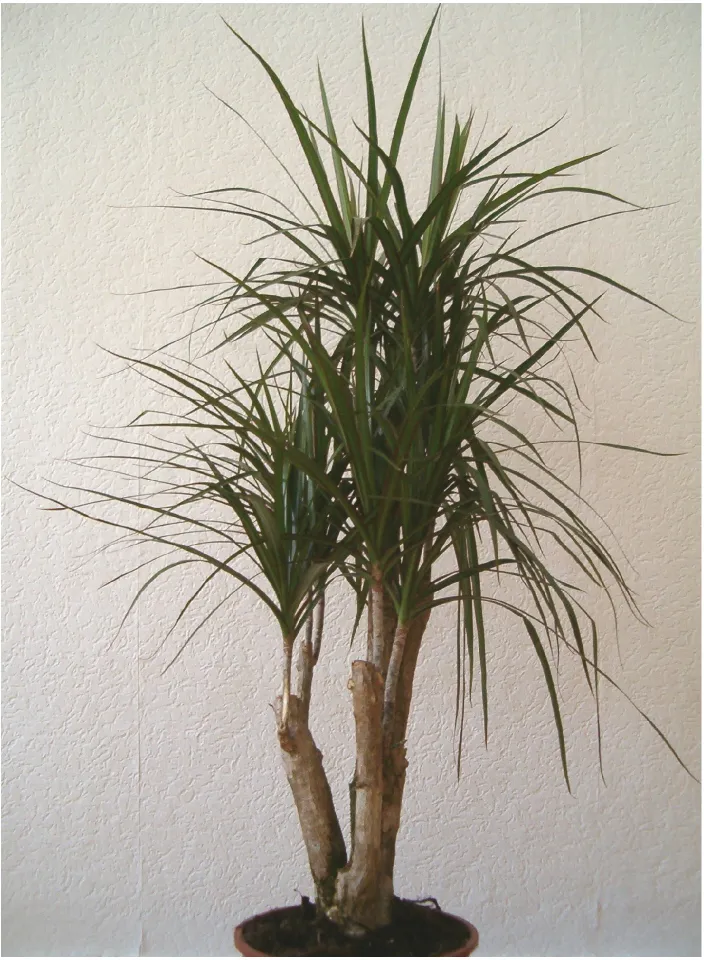
Dracaena marginata grows as a slim woody stem topped with a spray of narrow leaves edged in red. Older plants develop several stems at different heights, which is where the sculptural look comes from.
It grows slowly and lives a long time.
Light
Dracaena marginata grows best in bright, indirect light, which keeps the red leaf edges strong. It also copes well with medium light.
Too little light
The leaves lose their red edging and the stem stretches, leaning toward the window with wider spacing between leaves.
Too much light
Direct sun bleaches the leaves and leaves dry patches.
Watering
Water when the top 5cm (2 inches) of soil is dry, then let it drain fully. This plant is drought tolerant and dislikes wet soil.
On average:
- Spring & summer: every 1-2 weeks
- Autumn & winter: every 3-4 weeks
Signs of overwatering
- Leaves yellow and drop from the lower part of the crown
- The stem feels soft or spongy
- Soil stays wet for days
Signs of underwatering
- Leaves curl inward along their length
- Whole leaves go dry and drop
Use filtered water
Dracaena marginata is unusually sensitive to fluoride, which is added to most tap water. It builds up in the leaf tips and shows as brown, dead points that gradually creep down the leaf.
Filtered, distilled or rainwater prevents it. This is the single most common complaint about the plant and it has one fix.
Humidity and temperature
Ordinary household humidity is fine. Keep it between 15°C and 27°C (59-80°F) and away from cold draughts.
Soil and repotting
Soil
Free-draining compost with added perlite.
Repotting
Every 2 to 3 years in spring. They are slow and cope well with being pot-bound, so there is no need to rush.
Feeding
Balanced liquid fertiliser every 6 to 8 weeks through spring and summer. Nothing in winter. Overfeeding contributes to the brown tips.
Pruning and grooming
The stem can be cut at any height. It will branch just below the cut, usually into two or three new heads, which is how you make a plant fuller instead of taller.
The cut section can be rooted as a new plant. Wipe the leaves occasionally to keep them glossy.
Common problems
Brown leaf tips
Fluoride in tap water, most of the time. Switch to filtered water and flush the pot through to clear what has built up.
Yellow leaves dropping from the base
Normal in small numbers as the plant grows upward and sheds the oldest leaves. Several at once means overwatering.
Bare, leggy stem
Natural for a mature plant, since it drops lower leaves as it grows. Cut the stem back if you want it fuller.