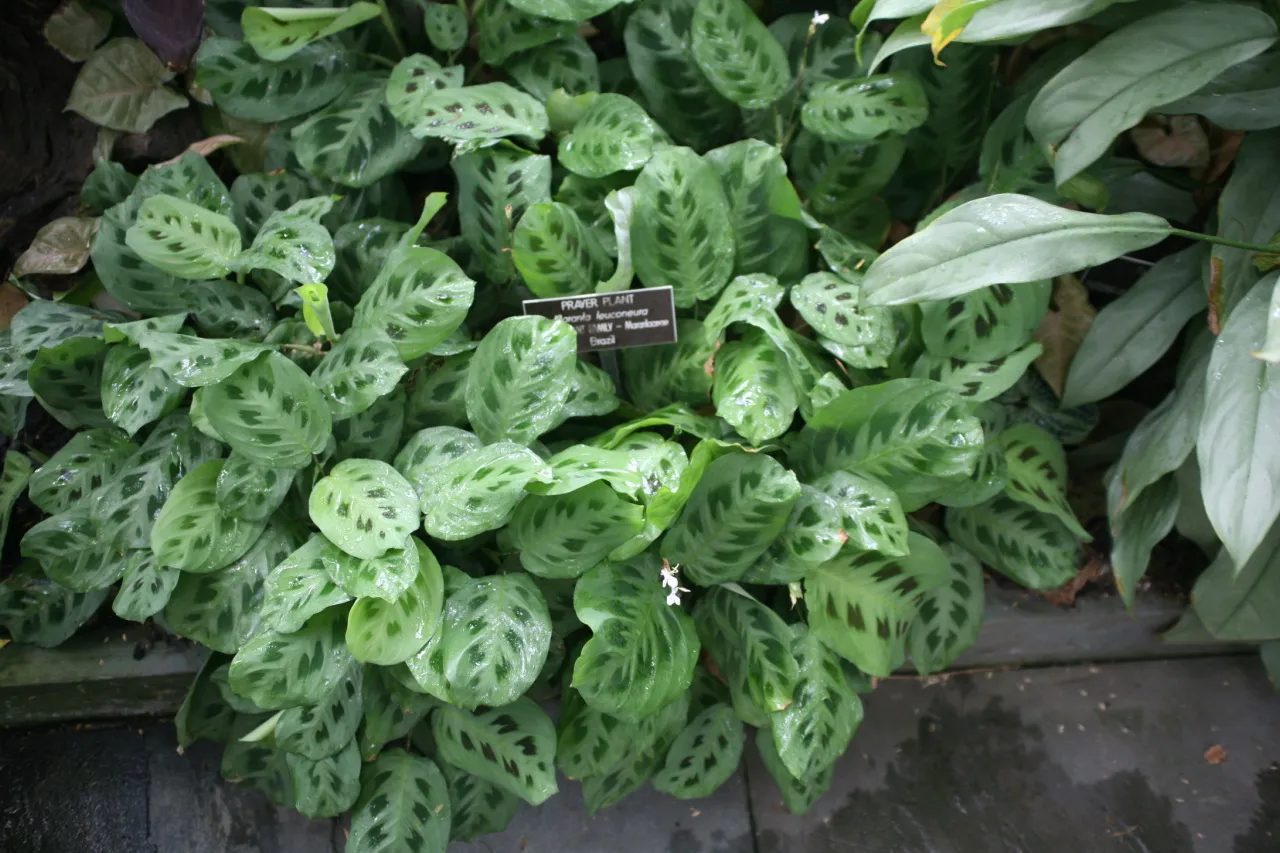
Maranta leuconeura grows low and spreads sideways, with oval leaves marked in dark green, pale green and red veining. At night the leaves fold upright, and in the morning they lower again.
It is non-toxic to cats and dogs, which makes it one of the better dramatic foliage options for a pet household.
Light
Maranta leuconeura grows best in medium to bright indirect light. It handles lower light better than most patterned plants.
Too much light
Direct sun bleaches the markings and fades the red veining permanently.
Too little light
The leaves stop folding at night and new growth comes in with weaker patterning.
Watering
Keep the soil lightly moist at all times. Water when the top 2cm (0.5 inch) feels dry, and do not let it dry out completely.
On average:
- Spring & summer: twice a week
- Autumn & winter: once a week
Use filtered or rainwater if you can. Maranta leuconeura is sensitive to fluoride and chlorine, which show as brown leaf edges.
Signs of overwatering
- Leaves yellow and go limp
- Stems go soft at the base
- Soil stays wet for days
Signs of underwatering
- Leaves curl inward tightly
- Edges go crisp and brown
- Leaves stay folded during the day
Humidity and temperature
Humidity above 50% is the difference between a good Maranta and a struggling one. Group plants together or run a humidifier.
Keep it between 18°C and 26°C (65-79°F), away from draughts and radiators.
Soil and repotting
Soil
A moisture-retentive but airy mix. Coco coir or peat with perlite works well.
Repotting
Every 2 years in spring, into a wide shallow pot rather than a deep one. The roots are shallow and spreading.
Feeding
Half-strength balanced fertiliser once a month through spring and summer. Nothing in winter. They are sensitive to fertiliser salts, so underfeed rather than overfeed.
Pruning and grooming
Trim leggy stems back to encourage bushier growth. Every cutting will root in water, so a Maranta is easy to keep going indefinitely.
Remove brown or damaged leaves at the base.
The prayer movement
The leaves fold upright at night and open flat during the day, following a daily rhythm. It is the most visible sign of a plant that is doing well.
A Maranta that has stopped moving, or stays folded through the day, is usually short of water or light.
Common problems
Brown crispy edges
Water quality first, humidity second. Switch to filtered water and raise the humidity.
Curled leaves that stay curled
Underwatering, or the air is too dry.
Faded patterning
Too much direct light.
Leggy, sparse growth
Not enough light. Cut it back and move it brighter.