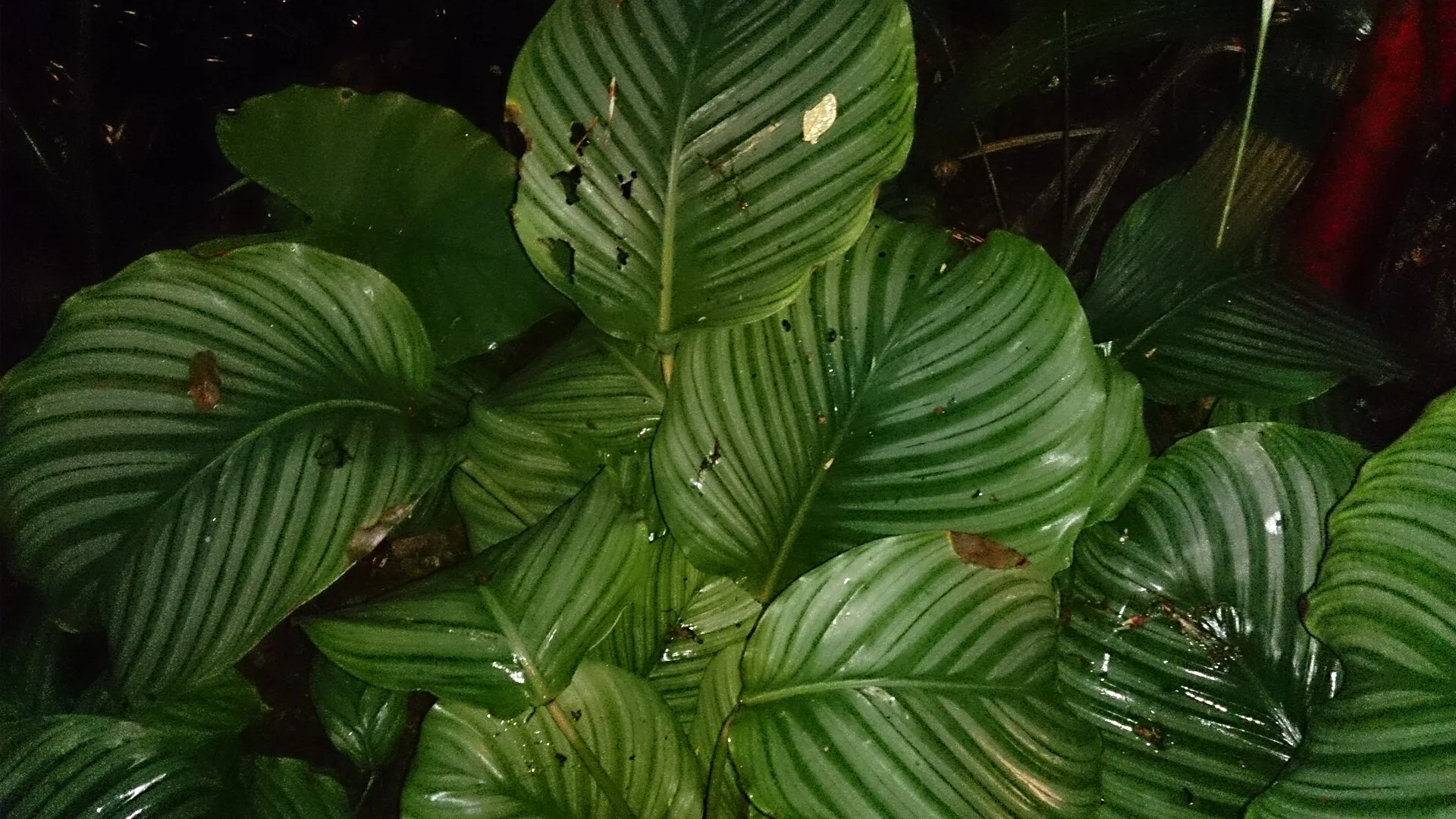
Calathea orbifolia has the largest and arguably most striking leaves in the genus, broad silver-striped rounds reaching 30cm (12in) across.
It is also one of the fussiest common houseplants, and it is routinely sold to beginners who have no idea what they are taking on.
Light
Calathea orbifolia grows best in medium to bright indirect light. Enough light to sustain those large leaves, and never direct sun.
Too much light
An hour of afternoon sun bleaches the silver striping permanently.
Too little light
Growth slows, new leaves come in small, and the leaves stop moving at night.
Watering
This is where Calathea are lost, and it deserves more attention than everything else combined.
Keep the soil lightly moist at all times. Unlike most houseplants, letting it dry out fully is a genuine setback rather than a minor lapse. Standing water is still fatal though, so drainage has to be good.
On average:
- Spring & summer: twice a week
- Autumn & winter: once a week
Use filtered water
Calathea orbifolia is acutely sensitive to fluoride, chlorine and dissolved salts in tap water, and the damage shows as crisp brown leaf edges within weeks.
Use filtered, distilled or rainwater. Nothing else about this plant matters as much.
Signs of overwatering
- Leaves yellow and go limp
- Stems soften at the base
- Soil smells sour
Signs of underwatering
- Leaves curl inward tightly
- Edges go crisp and brown
- Leaves stay folded during the day
Humidity and temperature
Humidity above 60%, consistently. This is not negotiable with Calathea orbifolia. A humidifier or a naturally humid room works. A pebble tray does very little.
A bathroom with a window is close to ideal.
Keep it between 18°C and 26°C (65-79°F), well away from radiators, draughts and any sudden change in temperature.
Soil and repotting
Soil
A moisture-retentive but airy mix. Coco coir or peat with perlite. It needs to hold water without becoming waterlogged.
Repotting
Every couple of years in spring, going up one size. Calathea dislike disturbance and will sulk for a few weeks afterwards. This is normal.
Feeding
Quarter-strength balanced fertiliser once a month through the growing season, and nothing at all in winter.
Underfeed rather than overfeed. Calathea orbifolia is as sensitive to fertiliser salts as it is to tap water, and the symptom is identical.
Pruning and grooming
Trim damaged leaf edges with scissors, following the natural leaf outline rather than cutting straight across. Remove whole leaves at the base once they yellow.
Dust the large leaves gently with a soft damp cloth. The patterning is the entire point of the plant, and dust dulls it quickly.
The prayer movement
The leaves raise at night and lower during the day, following a daily rhythm. It is the most obvious sign of a happy plant.
A Calathea orbifolia that has stopped moving is usually stressed. Check light levels first, then the roots.
Common problems
Crispy brown edges
Water quality first, humidity second, fertiliser salts third. In that order.
Curling leaves
Underwatered, or the air is too dry.
Faded patterning
Too much direct light, bleaching the silver.
Yellowing lower leaves
Overwatering, or a pot that is not draining.
Stopped moving
Stress, usually light or root problems.