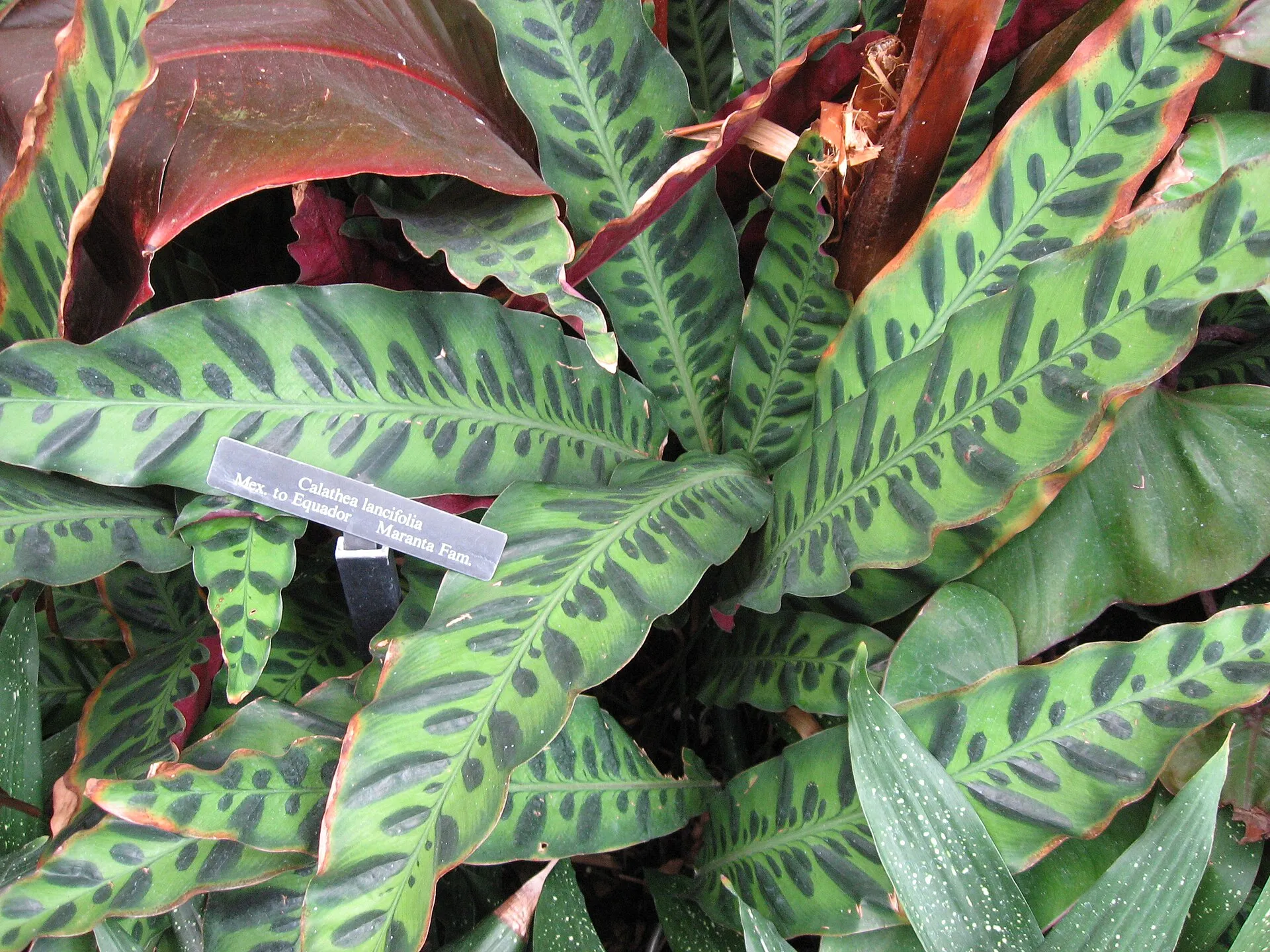
Calathea lancifolia has long, narrow, wavy-edged leaves marked with alternating dark green blotches, and deep purple undersides. The pattern is a close match for snakeskin.
It is the most forgiving Calathea commonly sold, which is worth saying carefully: it is easier than the rest of the genus, not easy.
Light
Calathea lancifolia grows best in medium indirect light. It tolerates lower light better than most Calathea.
Too much light
Direct sun fades the dark blotches and bleaches the purple undersides permanently.
Too little light
Growth slows, new leaves come in smaller, and the leaves stop moving at night.
Watering
Keep the soil lightly moist at all times. Water when the top 2-3cm (1 inch) is dry, and do not let it dry out fully.
On average:
- Spring & summer: twice a week
- Autumn & winter: once a week
Use filtered water
This is where Calathea are lost. They are sensitive to fluoride, chlorine and dissolved salts in tap water, and the damage shows as crisp brown leaf edges within weeks.
Filtered, distilled or rainwater prevents it. Nothing else about this plant matters as much.
Signs of overwatering
- Leaves yellow and go limp
- Stems soften at the base
- Soil smells sour
Signs of underwatering
- Leaves curl inward tightly
- Edges go crisp and brown
- Leaves stay folded during the day
Humidity and temperature
Humidity above 55% keeps the leaf edges clean. It is more tolerant than Calathea orbifolia, but this is still the main reason people struggle.
Keep it between 18°C and 27°C (65-80°F), away from draughts and radiators.
Soil and repotting
Soil
A moisture-retentive but airy mix. Coco coir or peat with perlite.
Repotting
Every 2 years in spring. It sulks for a few weeks after being disturbed, which is normal.
Repotting is also when to divide. A mature clump separates into several plants.
Feeding
Quarter-strength balanced fertiliser once a month through spring and summer. Nothing in winter. Fertiliser salts cause the same brown edges as tap water, so underfeed.
Pruning and grooming
Trim damaged leaf edges with scissors following the natural leaf outline, rather than cutting straight across. Remove whole leaves at the base once they yellow.
Dust the leaves gently. The patterning is the point of the plant.
The prayer movement
The leaves rise at night and lower during the day, following a daily rhythm. Calathea lancifolia moves more visibly than most, and it is the clearest sign of a happy plant.
A plant that has stopped moving is usually short of light or water.
Common problems
Crispy brown edges
Water quality first, humidity second, fertiliser third. In that order.
Curling leaves
Underwatering or dry air.
Faded markings
Too much direct light.
Stopped moving at night
Stress, usually light or roots.