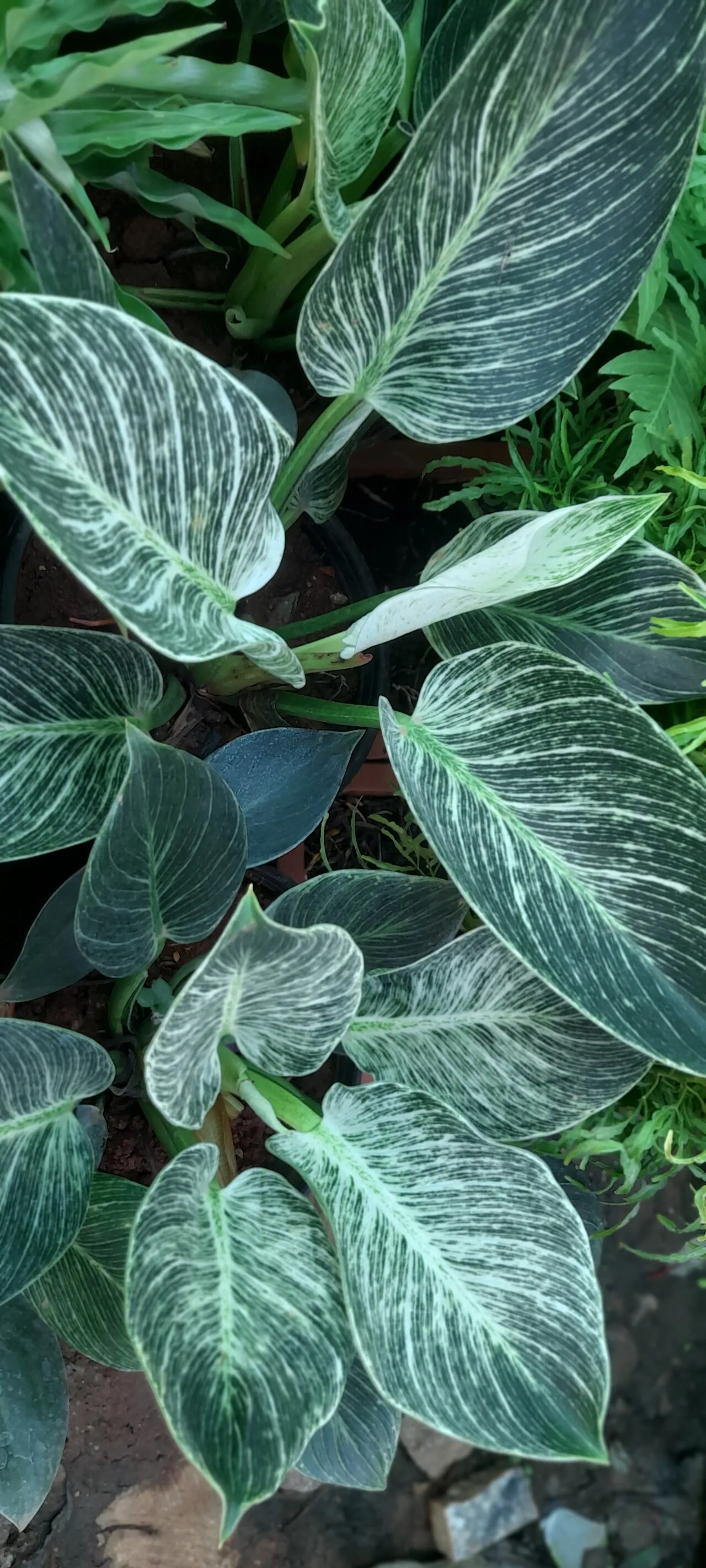
Philodendron 'Birkin' has dark green leaves marked with fine cream pinstripes that run out from the central vein. No two leaves carry the same pattern.
It is a cultivar with no wild parent. Birkin appeared as a spontaneous mutation on a Philodendron 'Rojo Congo', and every plant sold today descends from that one event.
Light
Philodendron 'Birkin' grows best in bright, indirect light. The variegation is directly tied to how much light it gets.
Too little light
New leaves come in with fewer stripes, or plain green. The plant will not correct itself, so the change is permanent for those leaves.
Too much light
Direct sun bleaches the cream stripes and scorches them brown. They are the least protected part of the leaf.
Watering
Water when the top 3-4cm (1-1.5 inches) of the potting mix feels dry.
On average:
- Spring & summer: once a week
- Autumn & winter: once every 2 weeks
Signs of overwatering
- Lower leaves yellow and drop
- Stems feel soft at the base
- Soil stays wet for more than a few days
Signs of underwatering
- Leaves curl inward
- Edges turn crisp and brown
- The whole plant looks slightly droopy
Humidity and temperature
Average household humidity is enough, though above 50% gives cleaner leaf edges. Keep it between 18°C and 27°C (65-80°F).
Soil and repotting
Soil
An airy aroid mix with bark and perlite. Birkin roots dislike sitting in dense wet compost.
Repotting
Repot every two years in spring. It grows slowly, so there is rarely any rush.
Feeding
Balanced liquid fertiliser once a month through spring and summer, at half strength. Nothing in autumn and winter.
Pruning and grooming
No shaping needed. Remove damaged or fully yellowed leaves at the base.
Wipe the leaves occasionally to keep the pinstripes visible. Dust settles into the pattern and dulls it quickly.
Reversion and pure white leaves
Birkin is genetically unstable, which is the whole reason it exists. Two things happen as a result.
Some plants revert, producing plain dark green leaves. Cut the reverted growth back to the last well-marked leaf, or the plant will keep going that way because green leaves grow more strongly.
Some produce almost pure white leaves. They look spectacular and cannot feed themselves, so the plant weakens if it makes several. Leave one, remove the rest.
Common problems
Leaves losing their stripes
Not enough light, or the plant is reverting. Move it brighter first, then prune back to well-marked growth if it continues.
Brown crispy edges
Dry air, or minerals building up from tap water. Raise the humidity and flush the pot through with plain water.
Yellow lower leaves
Usually overwatering. Let the mix dry out further between waterings.