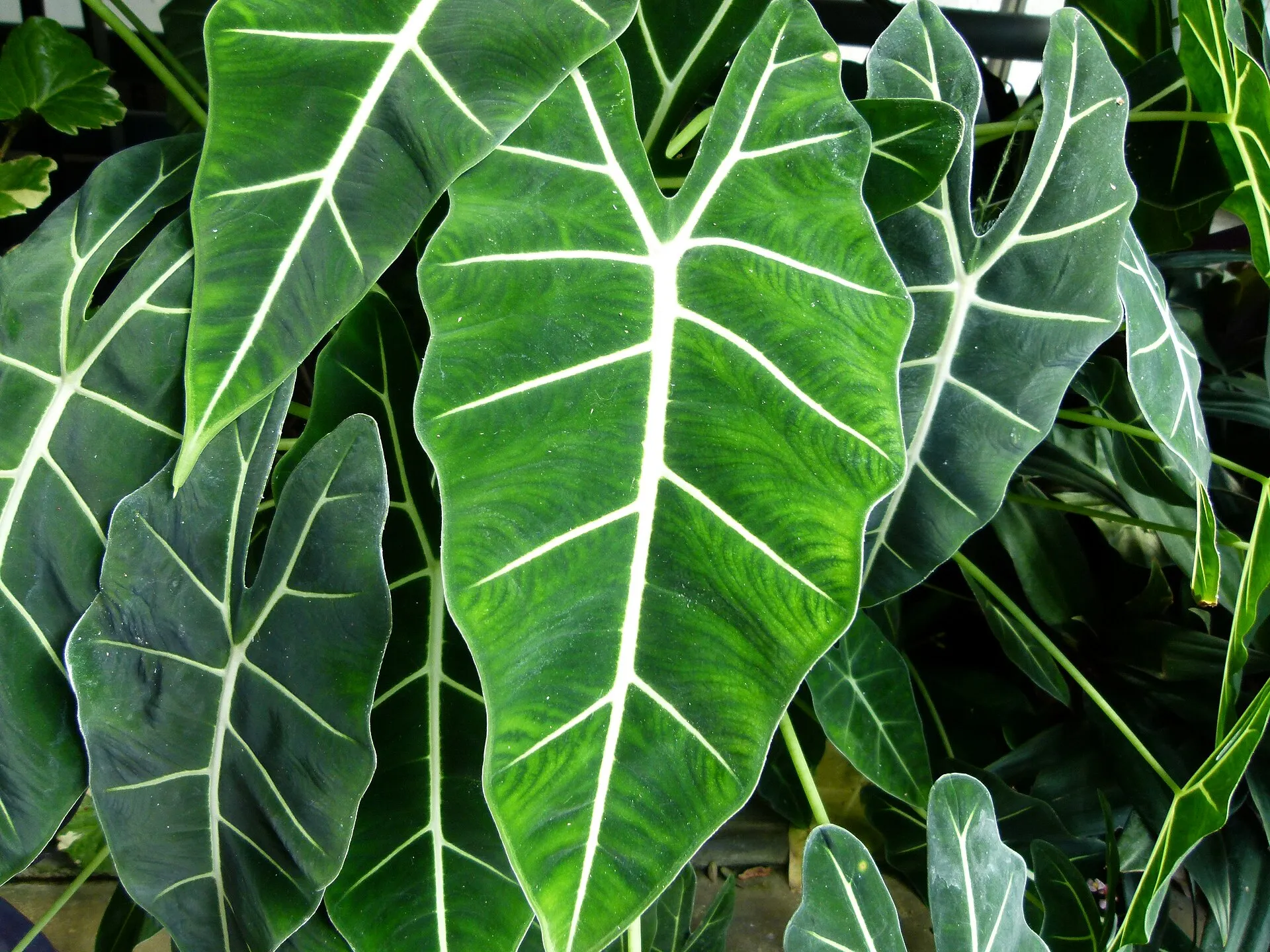
Alocasia micholitziana has arrow-shaped leaves in deep matte green with thick white veins, and a velvet surface texture.
You will almost never see it sold under this name. Nearly every plant in the trade is the cultivar 'Frydek', which is a selection of this species.
Light
Alocasia micholitziana grows best in bright, indirect light. The velvet surface burns faster than a glossy leaf would, so keep direct sun off it.
Too much light
Bleached dry patches, and the velvet texture going flat and dull.
Too little light
Stretched stalks, smaller new leaves, and weaker white veining.
Watering
Water when the top 3-4cm (1-1.5 inches) of the mix is dry, then let it drain fully.
On average:
- Spring & summer: twice a week
- Autumn & winter: once every 1-2 weeks
Signs of overwatering
- Leaves droop while the soil is wet
- Stalks soften at the base
- Roots brown and mushy
Signs of underwatering
- Leaves droop and stalks bend
- Leaf edges go crisp
Humidity and temperature
Humidity of 60% or above. Velvet-leaved Alocasia show dry air faster than the glossy ones.
Keep it between 18°C and 27°C (65-80°F), away from radiators and draughts.
Soil and repotting
Soil
A free-draining aroid mix of bark, perlite and coco coir.
Repotting
Every second spring, or when the corm fills the pot. Go up one size only.
Feeding
Half-strength balanced fertiliser every 3 to 4 weeks in spring and summer. Nothing in autumn and winter.
Pruning and grooming
Remove fully yellowed leaves at the base with clean scissors.
Do not wipe the velvet leaves with a damp cloth, because water marks the surface. A soft dry brush is safer.
Dormancy
It drops its leaves and retreats to the corm in low light or cold. Keep the soil barely damp, stop feeding, and wait for spring.
Common problems
Crispy brown leaf edges
Humidity too low.
Dull, flattened velvet texture
Too much direct light, or water marks.
Sudden leaf loss
Dormancy or a change in conditions.
Spider mites
Very common on this species. Check the undersides weekly.