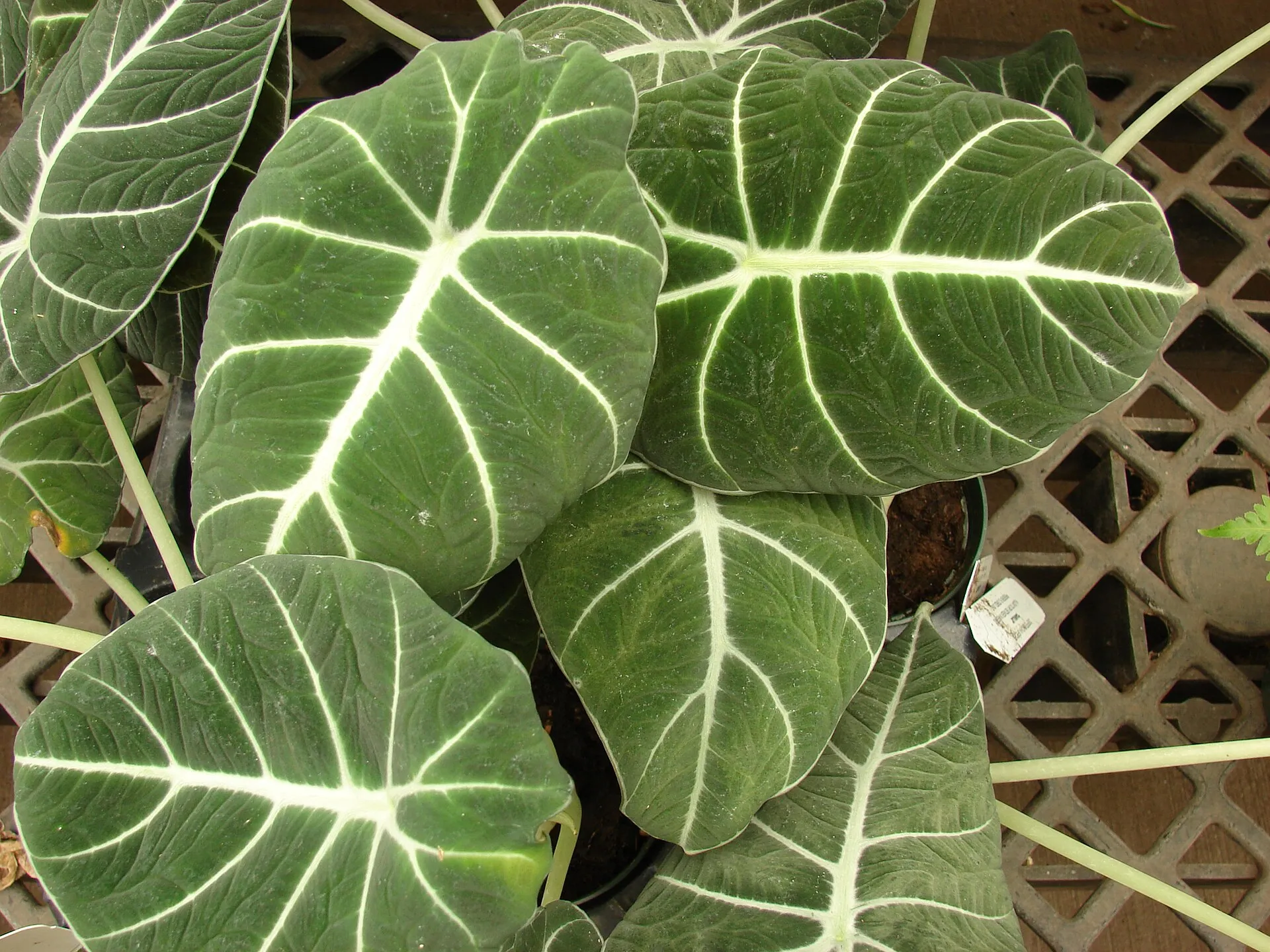
Alocasia reginula is a jewel Alocasia. Small, thick, heart-shaped leaves in near-black green with a matte velvet surface and pale silver veins.
Unlike the large Alocasia, it stays under about 30cm (12in) and grows slowly.
Light
Alocasia reginula grows best in medium to bright indirect light. The velvet leaf surface scatters light rather than reflecting it, and it scorches quickly in direct sun.
Too much light
The velvet texture goes dull and the leaf develops dry bleached patches.
Too little light
Growth stops almost entirely, and the stalks stretch.
Watering
This is where jewel Alocasia are lost. Alocasia reginula has a small corm and fine roots, and it rots faster than the larger species.
Water when the top 3cm (1 inch) is dry, and never let it sit wet.
On average:
- Spring & summer: once a week
- Autumn & winter: once every 2-3 weeks
Signs of overwatering
- Leaves yellow and drop suddenly
- Stalks go soft and translucent at the base
- Soil stays wet for more than a few days
Signs of underwatering
- Leaves droop and the stalks bend
- Leaf edges curl and crisp
Humidity and temperature
Humidity of 60% or above, and preferably higher. Jewel Alocasia do well in cabinets and terrariums for exactly this reason.
Keep it between 18°C and 27°C (65-80°F). It is less cold tolerant than the large Alocasia.
Soil and repotting
Soil
Very free-draining, heavy on perlite and bark with little compost. Many growers keep this species in pure sphagnum or semi-hydro for the drainage.
Repotting
Rarely, and only in spring. It has a small root system and dislikes being disturbed.
Feeding
Quarter-strength balanced fertiliser once a month through spring and summer. It is a small, slow plant and burns easily.
Pruning and grooming
Remove fully yellowed leaves at the base. Do not wipe the velvet leaves with a wet cloth, because it marks the surface. Use a soft dry brush instead.
Dormancy
It goes dormant readily, often losing every leaf over winter. The corm survives and pushes new growth in spring.
Keep it barely damp and warm, and do not throw it away.
Common problems
Sudden leaf loss in autumn
Usually dormancy rather than death. Check the corm.
Yellow leaves with soft stalks
Overwatering. This species is unforgiving about it.
Dull, patchy velvet
Too much direct light, or water marks from wiping the leaves.
Spider mites
Common in dry air. Check the undersides weekly.