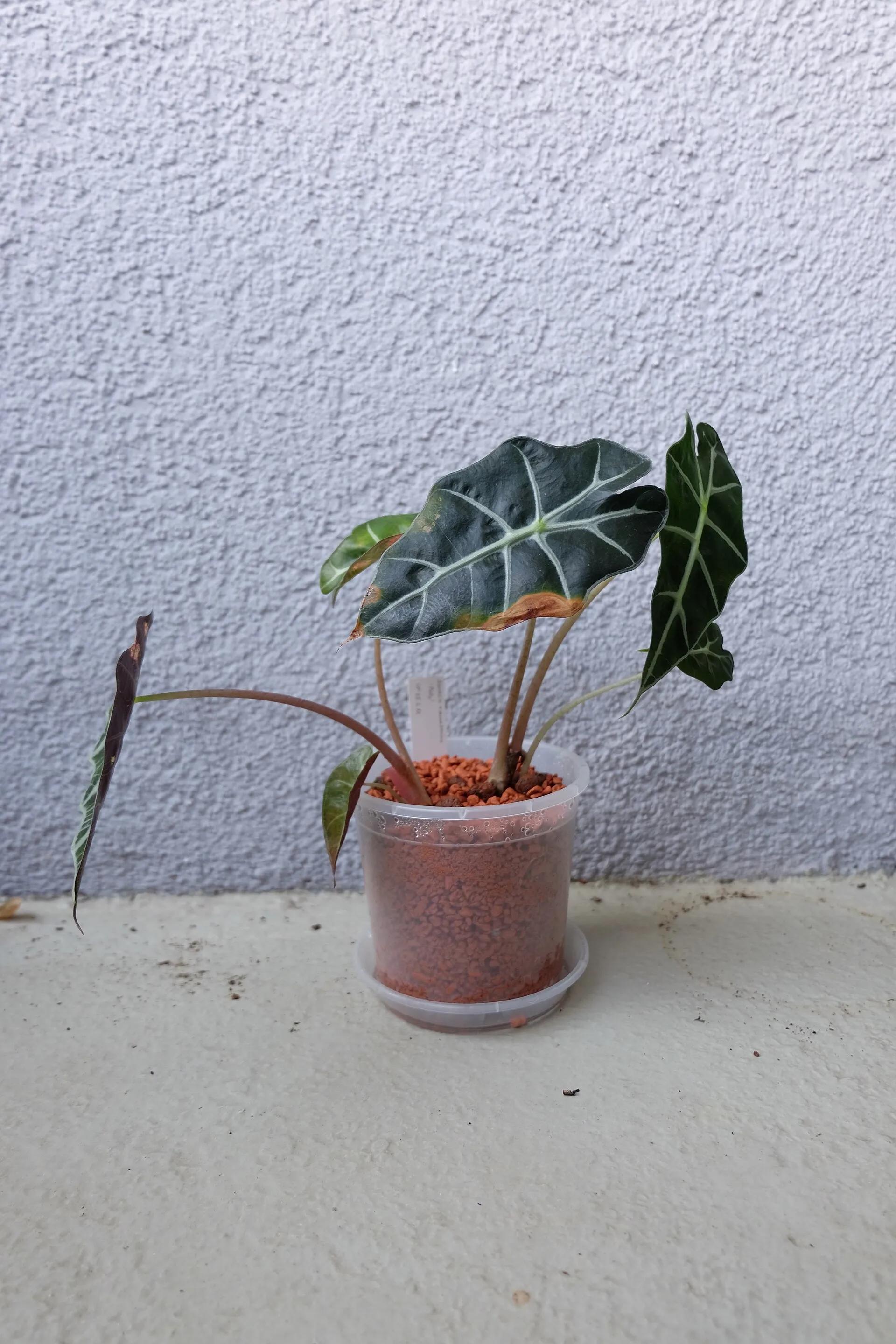
Two things to clear up first. 'Polly' is not an Amazonian plant. It is a cultivated hybrid, and the amazonica name comes from the nursery that first sold it.
And it is not dying. Polly drops leaves as a stress response far more readily than it actually gives up.
Light
Alocasia 'Polly' grows best in bright, indirect light, with no direct sun at all. The very dark, almost black-green leaves absorb heat efficiently and burn faster than a lighter-leaved Alocasia would.
An east-facing room, or about 1-2 metres (3-6ft) back from a brighter window, suits it well.
Too little light
The leaf stalks lengthen and lean, and the silver veining loses its contrast.
Too much light
Bleached patches that do not recover.
Watering
Consistency matters more than volume. Alocasia 'Polly' wants soil that stays lightly moist. Swinging between bone dry and saturated is what triggers the dramatic leaf drop it is famous for.
Let the top 3cm (1 inch) dry, then water thoroughly and let it drain.
On average:
- Spring & summer: twice a week
- Autumn & winter: once every 1-2 weeks
Signs of overwatering
- Leaves droop even though the soil is wet
- Stems soften at the base
- Roots turn brown and mushy
Signs of underwatering
- Leaves droop and the stalks bend
- Leaf edges go crisp and brown
Humidity and temperature
Humidity of 60% or above. Alocasia 'Polly' is a hybrid bred from rainforest species and it shows. In dry indoor air the leaf edges crisp and spider mites move in quickly.
A humidifier works. Misting does not.
Keep it between 18°C and 26°C (65-79°F), away from radiators and draughty doorways. Sudden temperature swings are one of the most reliable ways to trigger leaf drop.
Soil and repotting
Soil
A free-draining aroid mix with plenty of perlite. Polly grows from a corm that rots readily, so drainage matters more than richness.
Repotting
Only when genuinely pot-bound, in spring, moving up a single pot size.
Polly resents disturbance and will often drop leaves after repotting. That is a stress response, not failure, and it recovers.
Feeding
Half-strength balanced fertiliser every 3 to 4 weeks through spring and summer. Nothing from autumn until new growth resumes.
Flush the pot with plain water two or three times a year to clear built-up salts, which contribute to brown leaf edges.
Pruning and grooming
No shaping needed. Cut yellowed leaves away at the base with clean scissors once they have fully died back.
Check the leaf undersides whenever you water. Polly is more prone to spider mites than almost any other common houseplant, and catching them in week one is the difference between one treatment and a month of them.
Dormancy
A plant that has lost everything is usually dormant, not dead.
Keep the soil barely damp, stop feeding, leave the base undisturbed, and hold it somewhere warm. New leaves typically push through within a few weeks.
To check, dig gently and feel the base. Firm means alive. Soft and hollow means it has gone.
Common problems
Sudden total leaf loss
A reaction to change. See dormancy above.
Drooping despite moist soil
Root rot. Unpot and check. Healthy roots are firm and pale, rotten ones brown and mushy.
Fine webbing and pale stippling
Spider mites. Isolate and treat immediately.
Crispy brown edges
Humidity too low, or salts accumulating from tap water.