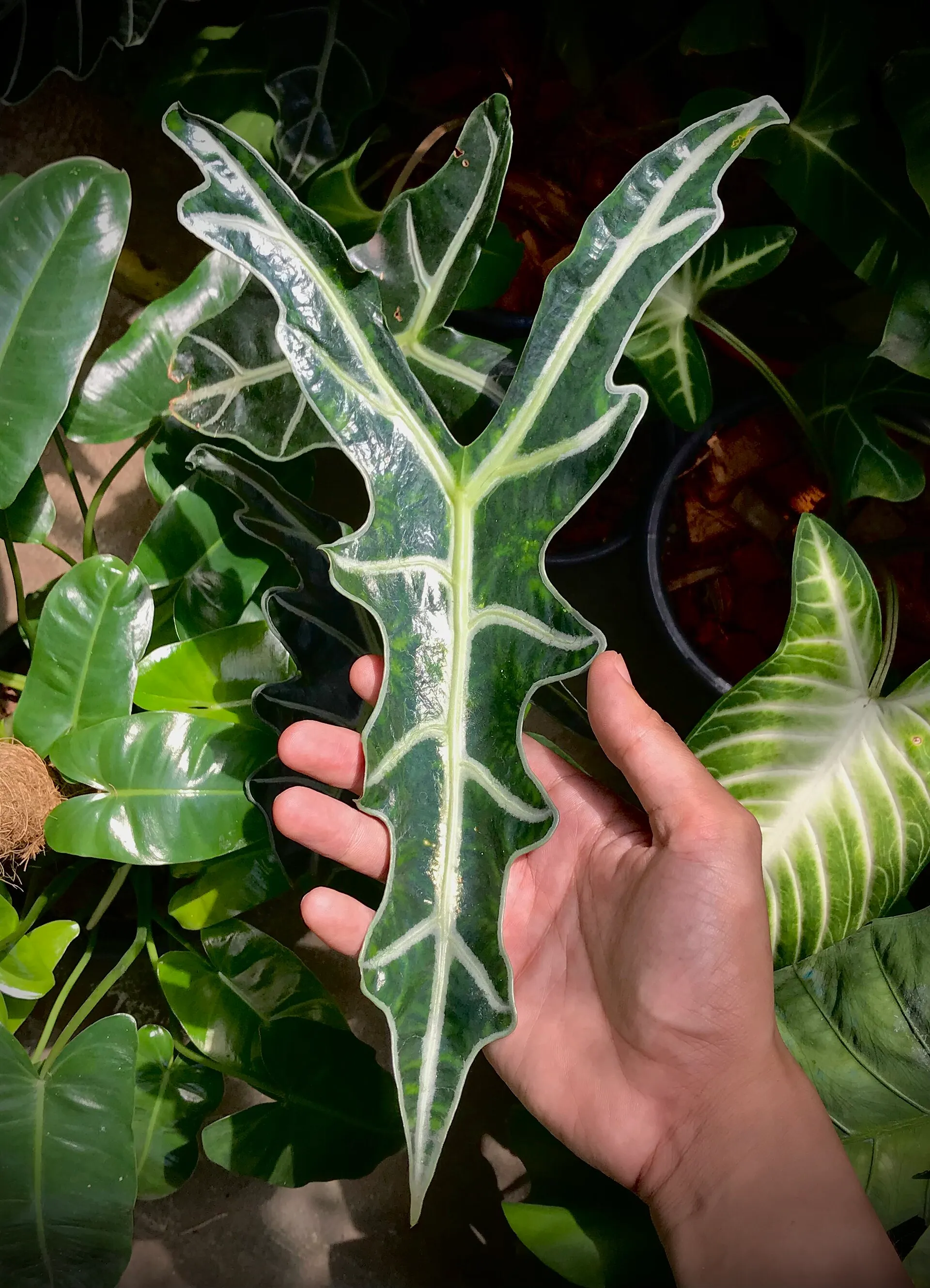
Alocasia sanderiana has narrow, deeply lobed leaves in near-black green, cut through with bright white veins and edged in a wavy silver line.
It is one of the parents of the Alocasia × amazonica hybrid, and much less common in shops than its own offspring. In the wild it is critically endangered, found only in a small area of the Philippines.
Light
Alocasia sanderiana grows best in bright, indirect light. The very dark leaves absorb heat well and burn faster than a paler Alocasia would.
Too much light
Bleached patches that never recover.
Too little light
The stalks stretch and lean, and the white veining loses its contrast.
Watering
Keep the soil lightly moist. Let the top 3cm (1 inch) dry, then water thoroughly and let it drain fully.
On average:
- Spring & summer: twice a week
- Autumn & winter: once every 1-2 weeks
Signs of overwatering
- Leaves droop while the soil is still wet
- Stalks soften at the base
- Roots go brown and mushy
Signs of underwatering
- Leaves droop and the stalks bend
- Leaf edges go crisp
Humidity and temperature
Humidity of 60% or above. This is one of the fussier Alocasia and the wavy leaf edges brown quickly in dry air.
Keep it between 18°C and 27°C (65-80°F), away from draughts.
Soil and repotting
Soil
A free-draining aroid mix with bark and perlite.
Repotting
Only when genuinely pot-bound, in spring. It resents disturbance and often drops a leaf or two afterwards.
Feeding
Half-strength balanced fertiliser every 3 to 4 weeks in spring and summer. Nothing in autumn and winter.
Pruning and grooming
No shaping needed. Cut fully yellowed leaves at the base.
Check the leaf undersides regularly for spider mites, which find this plant easily in dry air.
Dormancy
Like all Alocasia it can drop everything in low light or cold and retreat to the corm. Keep the soil barely damp, stop feeding, and wait.
Firm corm means alive. Soft and hollow means gone.
Common problems
Crispy, browning leaf edges
Humidity too low. The wavy margins are the first part to go.
Sudden leaf loss
A change in conditions, or the start of dormancy.
Fine webbing and stippling
Spider mites. Isolate and treat.
Drooping with wet soil
Root rot. Unpot and check.